
Lamborghini Revuelto, fait plus de 1000 chevaux
L’Aventador a enfin une héritière. Elle s’appelle Lamborghini Revuelto et c’est le nouveau fleuron technologique de la marque qui, avec cette biplace à moteur central, entre dans une nouvelle dimension technologique, stylistique et fonctionnelle. Au-delà des jeux de mots, le nouveau fleuron de la gamme Sant’Agata Bolognese représente une véritable révolution. Non seulement parce qu’il s’agit d’une voiture hybride, la première plug-in de la marque, la seule à ce jour capable de rouler avec zéro émission, mais aussi parce que son cœur V12 atmosphérique – les puristes peuvent pousser un ouf de soulagement – a été tourné de 180 degrés par rapport à la position traditionnelle et intègre désormais une boîte de vitesses à double embrayage à huit rapports (une autre première) montée transversalement et à l’extrémité arrière de la voiture.
La nouvelle Revuelto est un marqueur dans l’histoire de Lamborghini et un pilier de notre stratégie d’électrification », nous dit Stephan Winkelmann, le président de Lamborghini. Une voiture unique et innovante, mais en même temps fidèle à notre ADN : le V12 est le moteur emblématique de nos voitures super sportives et une partie importante de nos 60 ans d’histoire. Revuelto a été créée pour briser les codes, en combinant un nouveau moteur 12 cylindres avec une technologie hybride, en trouvant un équilibre parfait entre le désir d’offrir à nos clients des sensations sans précédent et la nécessité de réduire les émissions ».
Volkswagen Golf R “20 Years”: the family car asserts itself on the Nürburgring
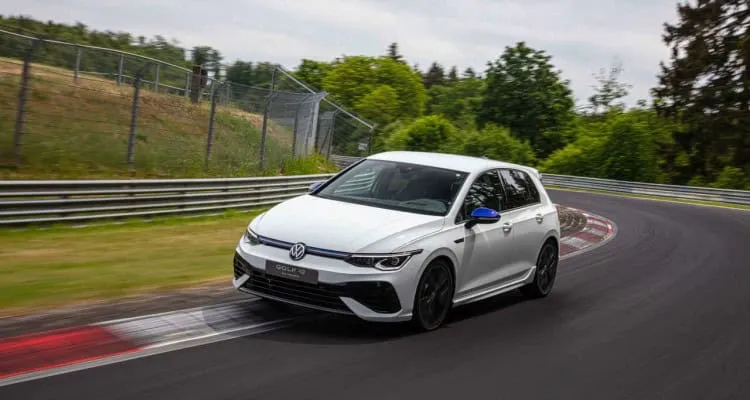
For those looking for a very sporty family car , the Golf R has long been a preferred choice. In its 20 years limited edition, this Golf demonstrates that on the racetrack it remains a valid option.
The 20 Years becomes the fastest Volkswagen Golf R in history on the Nürburgring. The 20 Years beats a “normal” Volkswagen Golf R by four seconds. Here is the full video.
Record at the Nürburgring
The 20 Years driven by Benny Leuchter took four seconds less than the conventional Golf R. Thus the Volkswagen overtook customers such as the Gallardo LP560-4, the Ferrari F430 F1 and the Mercedes A 45 AMG S.
However, the Golf is not the fastest compact car on the Nordschleife. That honor goes to the 2017 Honda Civic Type R (7:43.80) and in the front-wheel drive category to the 2019 Renault Megane RS Trophy-R.
Besides, it’s not even the fastest Golf of all time, since Volkswagen has found a Golf GTI Clubsport S, which did better in 2016. By 12 hundredths to be exact.
What is the Golf R 20 Years?
Created to celebrate 20 years of the R dynasty, the Volkswagen Golf R 20 Years, thanks to the 333 hp of the 2.0-litre 4-cylinder turbo engine, exceeds the power of the standard Golf R by 13 hp, making it the most powerful ever produced. This engine is mated to a DSG gearbox and the 4Motion all-wheel drive with R-Performance rear differential.
The 0 to 100 km/h comes out in 4.6 seconds (1 tenth less) and the top speed at 270 km/h as standard.
Optimized settings
From a dynamic point of view, the Volkswagen Golf R 20 Years is equipped as standard with the R-Performance package, which includes Torque Vectoring in combination with the Driving Dynamics Manager. The user can choose from five different driving profiles – comfort, sport, race, special and drift – which influence the steering, suspension and engine.
For the feat on the Nordschleife, the test driver chose the special driving profile, developed for this circuit. This latter profile gives the vehicle a configuration capable of meeting the demands of the Nürburgring; this includes adjusting the shock absorbers to a softer and more comfortable configuration, due to the high stresses that occur when crossing the curves of the German circuit at maximum speed.
The unfolding of the record
The timed lap of the Nürburgring took place with a flying start in front of the T13 grandstand (the start and finish are at the beginning and end of the grandstand, the intermediate 200 meters are not counted). The new settings and the improved engine with revised power allowed the Volkswagen Golf R 20 ans to set a record, reaching a speed of almost 240 km/h on the Schwedenkreuz crest, and 265 km/h on the Döttinger Höhe.
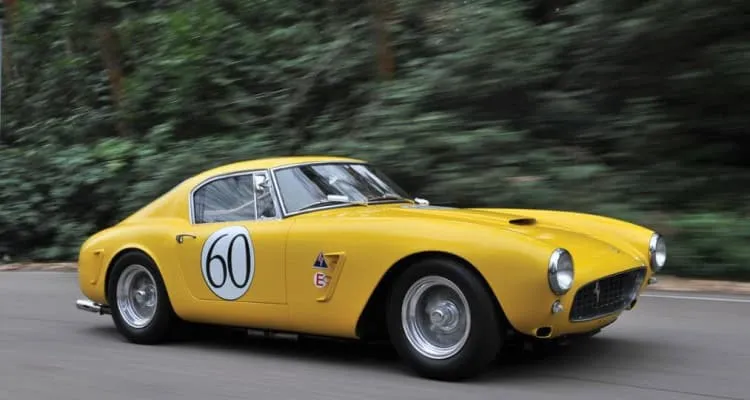
Mechanical Symphony in Ferrari 250 GT SWB [VID]
When the most beautiful berlinetta in the world produces the most beautiful mechanical melody imaginable. It's the 1960 Ferrari 250 GT SWB, driven here by our colleague from Evo UK Jethro Bovingdon, who is clenching his buttocks a little, given the price of the machine. He talks a bit too much, but from 5min50, it's the V12 that takes over. We understand - almost - why some people are ready to put 10 million euros into this kind of car (this one will be presented by RM Auctions - Sotheby's at the Villa d'Este on May 23). Open your ears wide!
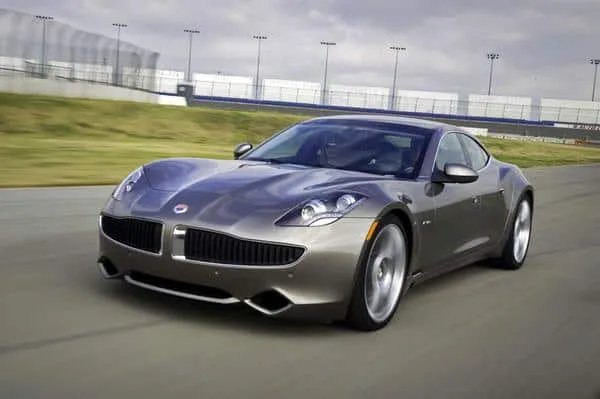
Ronin: Fisker's new upcoming jewel
American electric vehicle company Fisker has lifted the veil on its upcoming high-performance flagship Ronin. It’s an all-electric four-seater, four-door convertible that promises a range of 1,000 miles on a single charge. The car’s unique layout will put it in a class of its own when it arrives in 2024 and joins the brand’s lineup alongside the Ocean SUV.
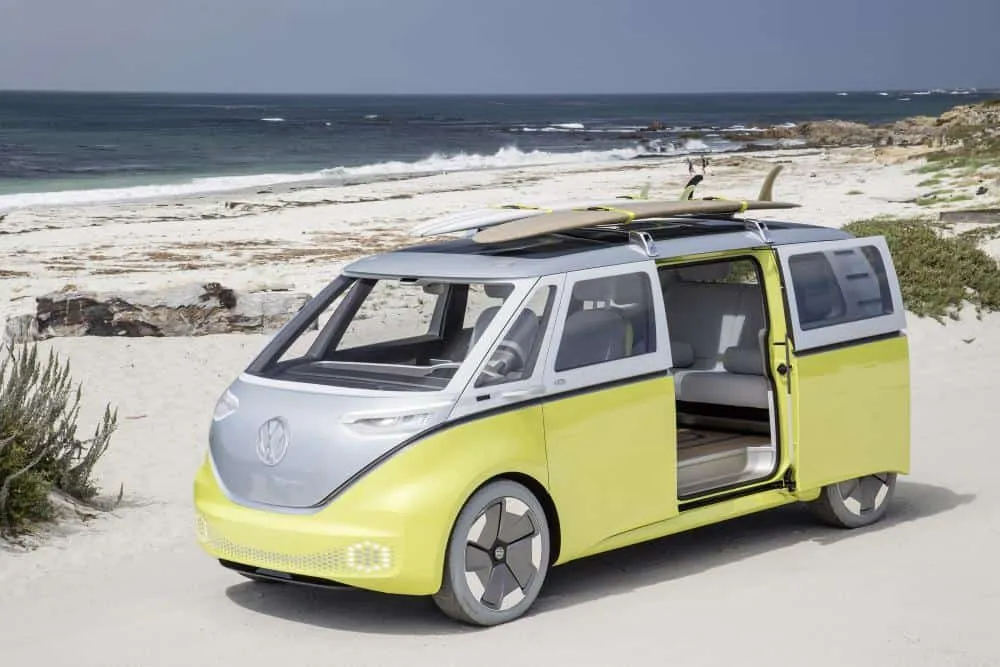
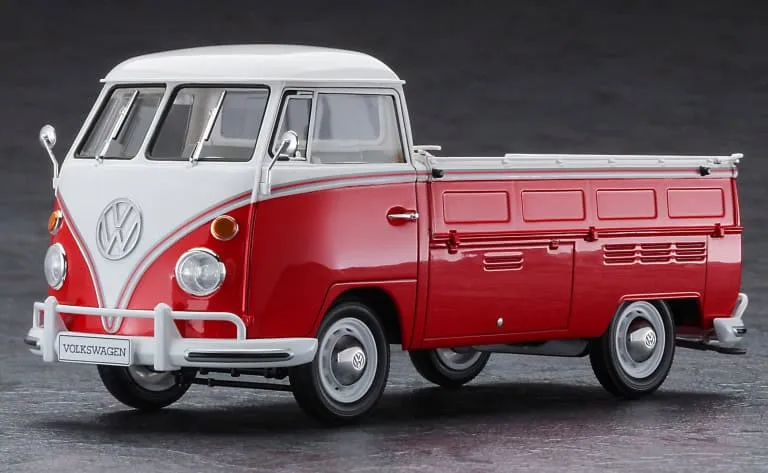
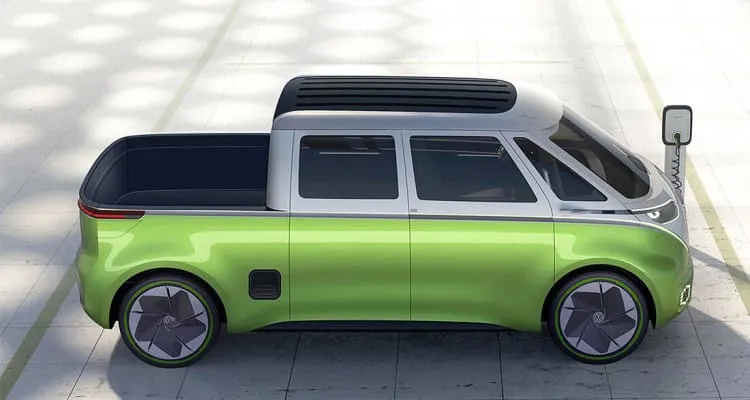
A new electric utility vehicle from VW?
Could the friendly ID. Buzz become a zero-emission pickup truck ? Volkswagen has reportedly filed a patent for a version of the car without a roof at the rear of the car, truncating the model beyond the C-pillar. In addition, we can see shorter rear doors, plastic cladding for some areas of the bodywork and a step in the rear wing. The side profile also shows aerodynamically designed wheels and a two-tone roof.
Unfortunately, that’s the only information that can be extrapolated from the rendering, but we assume that the Volkswagen ID. Buzz shares the same specifications as the recently announced minivan version. It’s equipped with an 82 kWh battery that offers a range of around 423 km on a single charge and a single rear-mounted electric motor that produces 204 hp and a maximum torque of 310 Nm.
The car was presented in the form of a “sketch” to celebrate World Design Day.
A patent doesn’t necessarily mean the car will go into production. But putting the idea of a pickup version of the ID. Buzz on paper suggests that Volkswagen is looking for an opportunity to enter a new market with a modern model, having explored this avenue in the past with some success.
The ID. Buzz will be used to bring different variants to life. We already know that a camper version will exist, the ID. California. A robotaxi version will debut to launch an autonomous passenger transport service in select cities in Germany.
Porsche 356, the 5 pillars of the myth
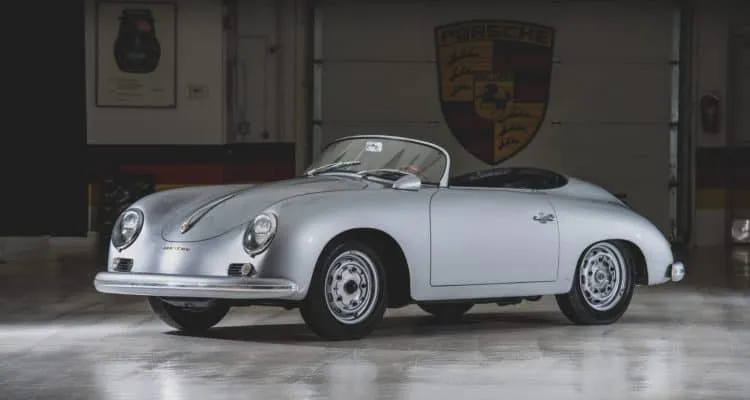
Porsche 356: the car that began the legend of the German manufacturer. On the occasion of its seventy-fifth anniversary and the launch of the auction site that everyone is talking about PistonAddict , let’s discover it through the 5 icons that founded the myth.
The legendary 356 No. 1.
It was from this small two-seater roadster with a V-shaped windshield and the four-cylinder 1100 boxer engine from the Beetle, hand-cut from thin aluminum sheets in the courtyard of a workshop in Gmünd, Lower Austria, that Ferdinand Porsche’s adventure began on June 8, 1948. His son Ferdinand Anton Ernst (Ferry) was part of the adventure from the very beginning.
“I couldn’t find the sports car of my dreams, so I built it myself”: Ferdinand Porsche was very clear about the consistency of his vision. In the 1930s, he had designed the Beetle on behalf of Hitler, who wanted to motorize Nazi Germany and show his power through the car. And from this car, Ferdinand Porsche created a lively and sensual spider that weighed less than 600 kg and needed only 40 hp to exceed 130 km/h.
Lightweight, eternally elegant in its formal “purity”, it quickly became a status symbol. The 356 became synonymous with Porsche until the mid-1960s, when the 911 arrived. In total, more than 76,000 examples left the Zuffenhausen plant on the northern outskirts of Stuttgart, which would become Porsche’s headquarters from the autumn of 1949.
The engine is a good starting point for understanding the soul of this car. In the very first Porsche 356, the four-cylinder boxer sits right in the middle, just behind the two-seater cabin. In contrast, in the model that rolled off the assembly line in 1948, it is set back behind the rear axle. Its cantilevered position, as well as its opposed cylinder arrangement, have become the signature of this car. The flat-six of the 911, after a generational leap (and two additional cylinders), uses the same architecture.
There are many stories in the history of Porsche. Some of them venture into an almost mythological dimension and refer to words that have now entered the common imagination of enthusiasts. Like Speedster: this term, in the glossary of the Zuffenhausen manufacturer, designates a type of minimalist spider body.
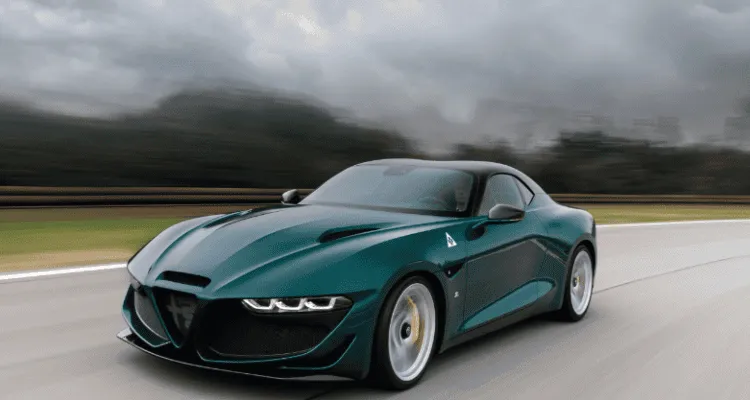
Alfa Romeo Giulia SWB Zagato: 540 hp and manual gearbox
Last year, coachbuilder Zagato celebrated 100 years since its first collaboration with Alfa Romeo, which began with the development of the Tipo G1. On this occasion, the two brands, proud of their past, launched a crazy project, combining the historical legacy of the twinning with the Biscione with cutting-edge technical solutions. Thus was born the idea of the Giulia SWB Zagato, a unique model intended for a wealthy German collector, a fan of the models of the Milanese brand and its coachbuilder.
Light, short and with 540 hp. Zagato’s latest work combines registers from different eras, combining the 540 hp 2.9 V6 of the Giulia GTAm with the manual gearbox of the Quadrifoglio and the carbon fiber bodywork – a first for the coupé – with a ‘shortened wheelbase (hence the name Short Wheel Base), derived from the wheelbase of the modern Giorgio, but typical of the company’s historic sports cars.
As this is a unique piece, Zagato has not given any information on performance, dimensions or weight.
Homage to the SZ of the 1960s and 1990s. The style of the Giulia SWB is inspired by the SZ series models and combines styling elements derived from the historic Codatronca of the 1960s and the SZ of 1989. Minimalist and elongated lines dominate with the truncated rear surrounded by LEDs, while at the front we find the two groups of three headlights typical of the sports car of the 90s, but also of the new Tonale. The double hump on the roof recalls the tradition to reduce the height while leaving space for the passengers. The team of the Centro Stile Alfa Romeo led by Alejandro Mesonero worked on defining the lines, even if the car is not a model developed by the Biscione, the development and production of the prototype having been entirely carried out by Zagato.
Essai Mazda MX-5 : un certain regard
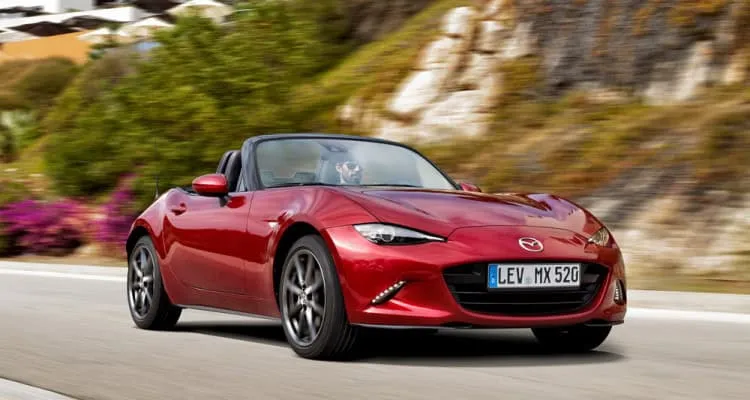
Elle n’en finissait plus d’arriver, entre concepts, teasers et présentation anticipée au Mondial de Paris de 2014. Dans le genre, elle rappelle les Honda Civic Type-R et NSX ; à croire que les Japonais se sont donné le mot. Enfin bref, nous voici aux commandes de la plus tellement nouvelle Mazda MX-5, dans ses versions 1,5 l et 2,0 l.
Dans ses grandes lignes, la MX-5 2015 demeure dans le sillon tracé par ses devancières. Voici un petit roadster à moteur atmosphérique placé à l’avant avec sa boîte de vitesses (ici à 6 rapports) mais qui envoie sa puissance au train arrière. Ses dimensions s’avèrent contenues (3,91 m de long sur 1,73 m de large), ce qui induit un poids minimal agréablement réduit : 975 kg en 1,5 l et 1 000 kg en 2,0 l (mesure faite sans conducteur).
Ceci a permis à Mazda de se contenter de blocs 4′-cylindres SKYACTIV-G (ça fait plaisir aux marketeux, ces appellations absconses) relativement peu puissants sans entrainer de performances ridicules : avec ses 131 ch (pour 150 Nm à 4 800 tr/min), la 1,5 l pointe à 204 km/h et passe de 0 à 100 km/h en 8,4 sec, selon le constructeur. La 2,0 l, forte de 160 ch et 200 Nm (à 4 600 tr/min), atteint 214 km/h et franchit les 100 km/h en 7,3 sec.
Malheureusement, en dépit d’un certain niveau technologique (injection directe, taux de compression très élevé – 13:1 -, double déphasage des arbres à cames) et du poids réduit, les consommations normalisées n’ont rien de spécialement attractif : 6,0 l/100 km (soit 139 g/km de CO2) pour la 1,5 l et 6,6 l/100 km (soit 154 g/km) pour la 2,0 l équipée du stop and start.
On se consolera avec un châssis ma foi fort alléchant : doubles triangles à l’avant, essieu multibras à l’arrière, crémaillère à double pignon, structure mêlant acier et aluminium et, cerise sur le gâteau, différentiel à glissement limité en option sur la 2,0 l.